
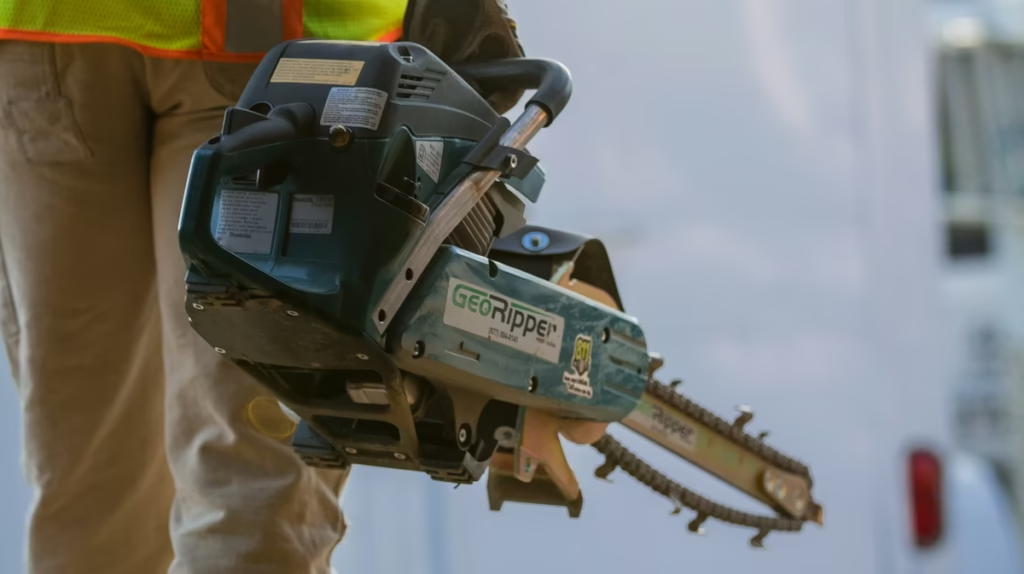

In today’s world, where precision, efficiency, and technological innovation dominate the landscape of construction, agriculture, and environmental management, tools like the Geo Ripper are quietly reshaping the way professionals work. If you’ve been wondering, what is Geo Ripper and how does it work?—you’re about to discover a device that combines brute force, smart engineering, and adaptability in ways that make traditional methods seem almost outdated.
Understanding Geo Ripper: Beyond the Name
At first glance, the term “Geo Ripper” might conjure images of heavy machinery tearing through soil or rock. While not entirely inaccurate, the reality is far more sophisticated. Geo Ripper is a specialized attachment or standalone device designed to penetrate, loosen, and prepare the ground efficiently. Its primary purpose is to break up compacted soil, rock, or other substrates, making it easier for construction, landscaping, or agricultural projects to move forward.
Unlike conventional digging tools or plows, a Geo Ripper doesn’t just push or slice the surface—it works with precision. It targets resistance points in the ground, creating fractures that reduce effort in subsequent excavation, planting, or treatment processes. Think of it as a surgeon using a scalpel rather than a butcher wielding a cleaver: every movement is deliberate, controlled, and effective.
How Geo Ripper Works
Mechanically, the Geo Ripper operates on a simple yet powerful principle: concentrated force applied at strategic points. Most models feature sharp, durable tines or teeth, reinforced with high-grade steel, designed to penetrate tough surfaces. These tines are mounted on a frame that attaches to tractors, excavators, or specialized rigs.
When engaged, the Geo Ripper tines dig deep into the substrate, breaking up hard-packed layers without disturbing the surrounding area unnecessarily. Some advanced models incorporate hydraulic or pneumatic systems, allowing operators to adjust depth, angle, and pressure in real time. This adaptability ensures that the device can handle different soil types, from dense clay to rocky terrain, with optimal efficiency.
Practical Applications of Geo Ripper
Understanding what is Geo Ripper also means appreciating its versatility. Its uses stretch across industries:
-
Agriculture: Farmers use Geo Rippers to aerate compacted soil, improving water absorption, root growth, and crop yield. By loosening the earth without completely overturning it, they maintain soil structure while enhancing fertility.
-
Construction: In sites with hard soil or rocky ground, Geo Rippers reduce the need for heavy excavation equipment. This saves time, fuel, and money, making projects more sustainable and manageable.
-
Landscaping and Environmental Restoration: Geo Rippers help restore degraded land by breaking compacted surfaces, allowing native plants to take root and ecosystems to regenerate naturally.
Real-world examples make its impact tangible. On a vineyard in California, using a Geo Ripper allowed the soil to breathe and absorb nutrients more effectively, resulting in healthier vines and higher-quality grapes. Meanwhile, a landscaping project in an urban park leveraged a Geo Ripper to prepare the ground for tree planting, minimizing disruption to nearby walkways and existing greenery.
Tips for Using Geo Ripper Effectively
To harness the full potential of a Geo Ripper, beginners and professionals alike need to follow some practical guidelines:
-
Assess the Terrain: Understand soil type, compaction level, and obstacles. Geo Ripper excels when used strategically, not blindly.
-
Adjust Depth and Pressure: Over-penetration can damage underlying structures, while under-penetration reduces effectiveness. Find the balance for your specific project.
-
Use Proper Attachments: Ensure that the tines or teeth are suited for the soil or substrate. Hardened steel works for rocky areas; flexible tines may be better for softer soils.
-
Maintain the Equipment: Regular inspection, lubrication, and cleaning ensure that your Geo Ripper performs at peak efficiency. A dull or damaged tine can dramatically reduce results.
The Future of Geo Ripper Technology
As technology advances, the Geo Ripper is evolving beyond its original design. Automation, sensor integration, and AI-driven mapping are becoming standard features in high-end models. Imagine a Geo Ripper that scans the terrain ahead, adjusts tine depth on the fly, and optimizes energy use to reduce fuel consumption—all while minimizing soil disruption. The possibilities are not science fiction—they are emerging realities.
Conclusion
So, what is Geo Ripper and how does it work? At its essence, it’s a precision tool that transforms the way we interact with the earth. Whether loosening soil for agriculture, preparing a construction site, or restoring degraded land, the Geo Ripper combines strength, intelligence, and versatility. For professionals and enthusiasts alike, it’s more than just equipment—it’s a method for working smarter, not harder.
In a world where efficiency and sustainability are increasingly prized, the Geo Ripper stands as a testament to the power of innovation: simple in concept, extraordinary in execution.