
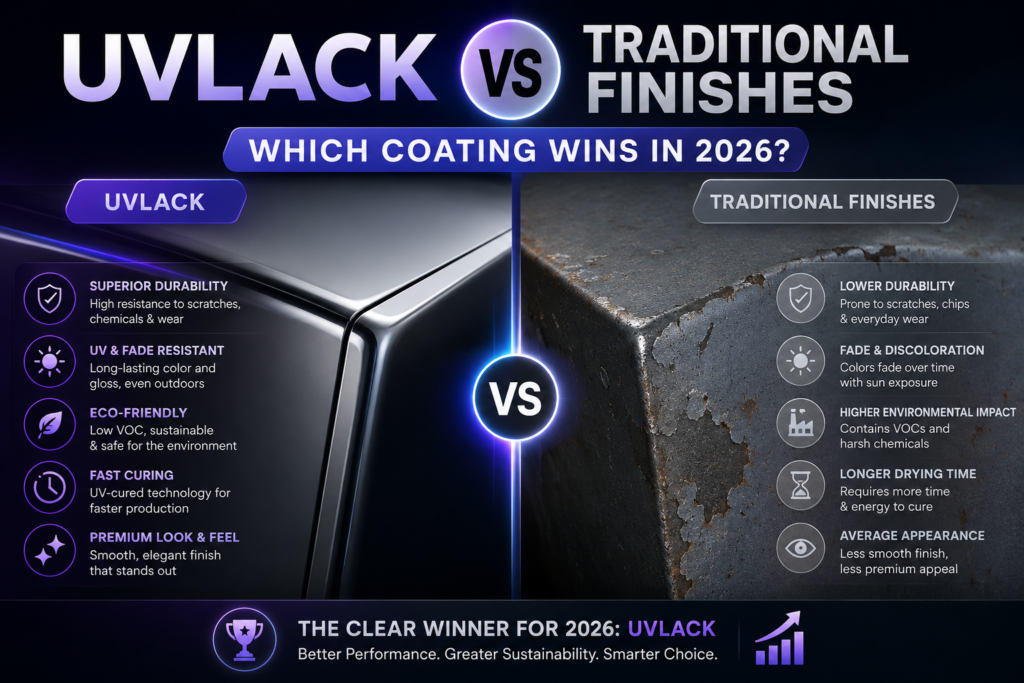

Surface finishing has come a long way, and few topics spark more debate among manufacturers, designers, and finishers than the choice between uvlack and traditional coating methods. As production demands grow faster, greener, and more design-driven, the question of which finish actually delivers better results in 2026 deserves a closer look.
This article compares uvlack against conventional finishing options across the factors that matter most: speed, durability, appearance, cost, and sustainability — helping you decide which coating truly wins for your application.
What Makes Uvlack Different
Uvlack is a UV-curable lacquer that remains liquid until exposed to ultraviolet light, at which point it hardens almost instantly into a tough, protective film. Traditional finishes — varnish, lamination, aqueous coatings, and solvent-based lacquers — rely on air drying, heat, or chemical reactions that take far longer to complete.
That single difference in curing mechanism is the root of nearly every advantage uvlack holds over older systems. But “faster” doesn’t automatically mean “better” for every job, which is why a side-by-side comparison matters.
Speed and Production Efficiency
Traditional varnishes can take hours, sometimes days, to fully cure. Aqueous coatings dry faster than solvent-based options but still require controlled drying tunnels. Lamination requires a separate film-application step entirely.
Uvlack cures within seconds to a few minutes under UV exposure, allowing products to be stacked, packaged, and shipped almost immediately. For high-volume production lines, this difference alone can transform throughput.
Winner in 2026: Uvlack, by a wide margin, for any operation where production speed affects bottom-line output.
Durability and Surface Protection
Traditional varnish offers reasonable protection but tends to wear down faster under repeated handling, moisture, and UV exposure from sunlight. Lamination is excellent against tearing and physical abuse on thicker substrates, but it can be harder to repair once damaged.
Uvlack forms a cross-linked polymer network that resists scratching, abrasion, and light moisture exposure exceptionally well. It also includes UV blockers that help prevent fading. However, on items with deep folds or creases, uvlack can crack where aqueous coatings would flex without damage.
Winner in 2026: It depends on the substrate. For flat or lightly-folded surfaces, uvlack wins. For packaging with tight folds or maximum tear resistance, lamination or aqueous coatings still hold an edge.
Appearance and Finish Quality
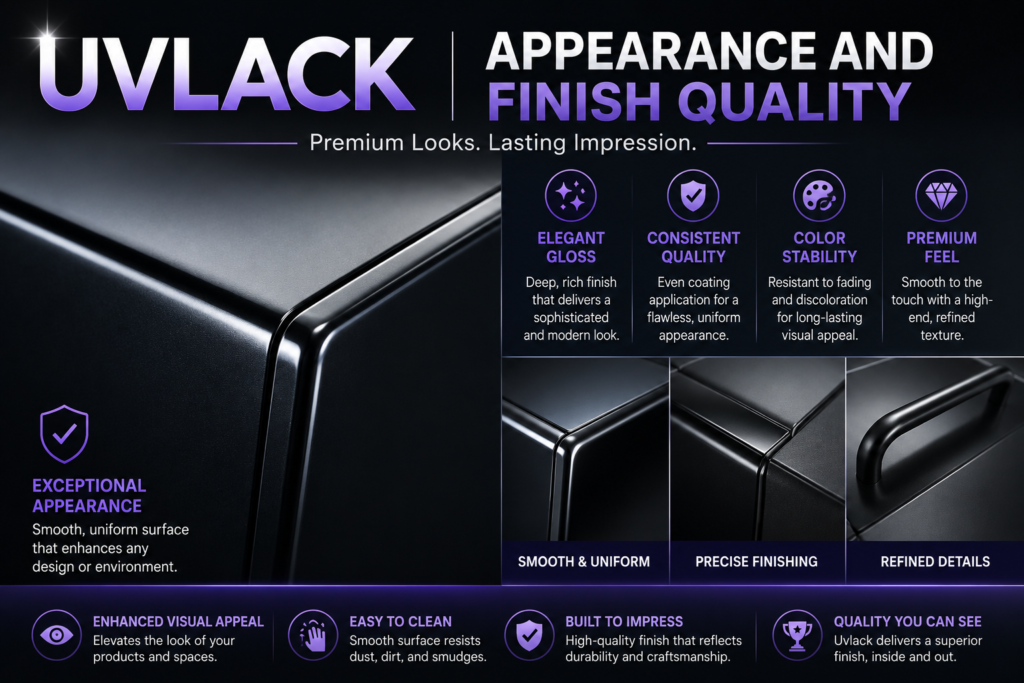
This is where uvlack arguably shines brightest. The range of available finishes — gloss, matte, satin, soft-touch, textured, and clear — gives designers far more creative control than most traditional coatings allow. Spot UV techniques, where glossy coating is applied only to specific design elements, create a tactile contrast that flat printing or standard varnish simply cannot replicate.
Traditional varnish does offer a dependable matte or gloss look, but it generally lacks the same depth, richness, and tactile variety.
Winner in 2026: Uvlack, especially for premium packaging, branding, and consumer products where shelf appeal matters.
Cost Considerations
Here, traditional coatings can still hold their ground — particularly for smaller operations or simple jobs. UV curing equipment requires a meaningful upfront investment, which can be a barrier for businesses with lower production volumes.
That said, once the equipment is in place, uvlack often becomes more cost-efficient over time. Faster curing reduces labor, storage space, and energy use compared with thermal drying systems, and material waste tends to drop as well.
Winner in 2026: Traditional coatings for low-volume or budget-constrained setups; uvlack for medium-to-high-volume operations where long-term savings outweigh initial investment.
Environmental Impact
Sustainability has become a deciding factor for many businesses heading into 2026, and this is another area where uvlack generally performs well. Most formulations produce significantly lower VOC emissions than solvent-based traditional coatings, and faster curing reduces overall energy consumption.
Newer deinkable uvlack formulations have also improved compatibility with paper recycling streams, addressing a long-standing criticism of UV coatings. Traditional aqueous coatings remain a strong eco-friendly choice too, particularly water-based options designed for recyclable packaging.
Winner in 2026: A close call — uvlack and modern aqueous coatings are both strong contenders, with the right choice depending on the specific formulation and recycling requirements of your packaging stream.
Where Each Option Still Makes Sense
Despite uvlack’s growing dominance, traditional finishes haven’t disappeared for good reason:
- Aqueous coatings remain better for packaging with deep folds or scores, where flexibility prevents cracking.
- Lamination still outperforms uvlack when maximum tear resistance is the top priority.
- Traditional varnish can be the more economical choice for small-scale or one-off projects without UV curing equipment.
- Black epoxy resin continues to serve applications needing extreme structural strength and thick-layer builds.
The Verdict: Which Coating Wins In 2026?
For most modern production environments — especially those prioritizing speed, premium appearance, and long-term sustainability — uvlack comes out ahead. Its combination of instant curing, durability, and aesthetic flexibility addresses the core demands of packaging, furniture, automotive, and electronics finishing in ways traditional coatings increasingly struggle to match.
That said, “winning” depends heavily on context. If your project involves tight folds, requires minimal upfront investment, or needs maximum tear resistance on thick materials, traditional finishes — particularly aqueous coatings and lamination — still have a meaningful role to play.
The honest answer for 2026: uvlack wins for the majority of high-volume, design-conscious applications, but smart manufacturers continue to choose the right tool for each specific job rather than treating any single coating as a universal solution.
Frequently Asked Questions
Is uvlack always better than traditional varnish? Not always. Uvlack offers faster curing and better gloss control, but traditional varnish remains cheaper to set up for simple, low-volume jobs.
Can uvlack be used on packaging with deep folds? It’s not ideal. Uvlack can crack along deep folds or scores, making aqueous coatings a better choice for that specific use case.
Does uvlack cost more than traditional finishes? The upfront equipment investment is higher, but uvlack often becomes more cost-efficient over time due to reduced drying time, labor, and energy use.
Is uvlack more eco-friendly than traditional coatings? Generally yes, especially compared to solvent-based options. Many uvlack formulations have low VOC emissions and newer deinkable versions support recycling.