
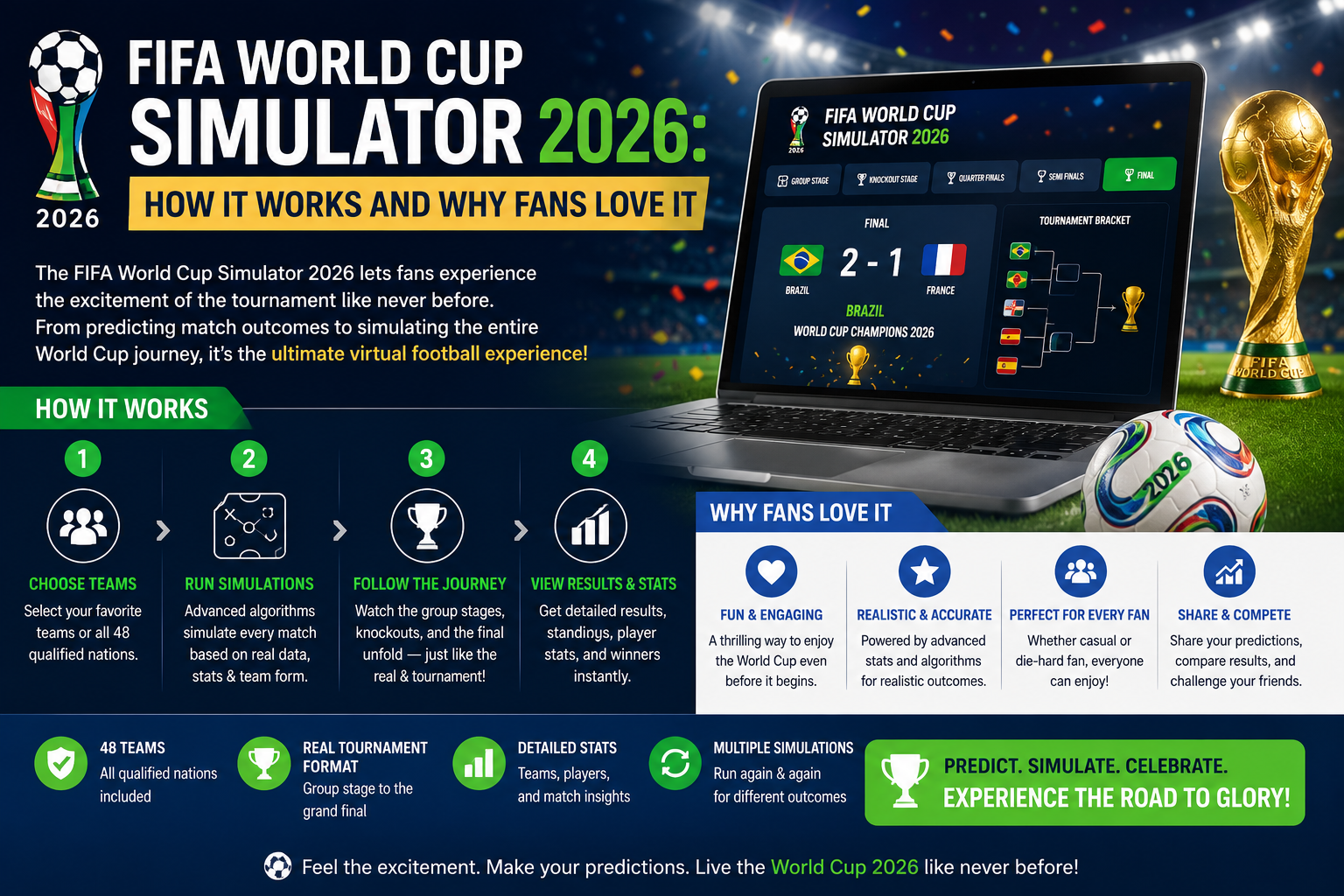
With the 2026 FIFA World Cup set to be the biggest tournament in the competition’s history, interest in World Cup simulators has surged. These interactive tools let fans predict match outcomes, build their own brackets, and see how the tournament could unfold — all before a single ball is kicked. Here’s everything you need to know about how a FIFA World Cup Simulator works and why it has become such a popular way to follow the tournament.
What Is a FIFA World Cup Simulator?
A FIFA World Cup Simulator is an online tool that lets users predict the outcomes of World Cup matches and see how those results play out across the tournament’s group stage and knockout rounds. Instead of just watching the real tournament unfold, fans can input their own scorelines and instantly see updated standings, qualification scenarios, and bracket paths.
These simulators are especially popular during major tournaments because they let fans engage actively with the competition — testing “what if” scenarios, settling debates with friends, and following along with the same structure FIFA itself uses.
Why the 2026 World Cup Is Different
The 2026 tournament introduces some major format changes that make simulators more useful — and more fun — than ever:
- 48 teams instead of 32 — the largest World Cup field in history
- 12 groups of 4 teams instead of the traditional 8 groups
- Three host nations — the United States, Mexico, and Canada — spread across 16 stadiums
- An expanded knockout stage, starting with a Round of 32 rather than straight into the Round of 16
Because the format is more complex than previous tournaments, simulators are especially useful for helping fans visualize exactly how teams advance, including tricky scenarios like which third-place group finishers qualify for the knockout rounds.
How Does a World Cup Simulator Work?
Most simulators follow a similar step-by-step process:
- Enter group stage scores — Users input predicted results for each match across all 12 groups.
- View live standings — As scores are entered, group tables update automatically based on points, goal difference, and other tiebreakers.
- Track third-place qualifiers — Since the best-performing third-place teams also advance, simulators calculate these scenarios automatically.
- Move into the knockout bracket — Once the group stage is complete, the simulator builds out the Round of 32 bracket and lets users continue predicting through the Round of 16, quarterfinals, semifinals, and final.
- Crown a champion — After simulating every round, users get their own personalized prediction for who lifts the trophy.
Key Features to Look For
Not all simulators are built the same way. The most useful ones typically offer:
- Automatic tiebreaker calculations — so users don’t have to manually work out group standings
- Visual bracket displays — making it easy to follow a team’s path to the final
- Save and share options — letting users save their bracket or share predictions with friends
- Mobile-friendly design — since many fans follow tournaments primarily on their phones
- Real tournament data — using the actual confirmed teams, groups, and fixtures once the draw is finalized
Why Fans Use World Cup Simulators
- Settling debates — simulators offer a fun way to test predictions against friends or online communities
- Understanding the format — with 48 teams and a more complex bracket, simulators help fans visualize how qualification actually works
- Tracking favorites — fans can map out exactly what their favorite team needs to advance
- Pure entertainment — for many fans, simulating the tournament is simply part of the fun leading up to kickoff
Tips for Getting the Most Out of a Simulator
- Use realistic scorelines based on team form, rankings, or recent results for more meaningful predictions
- Re-run the simulation with different scenarios to see how small changes affect the bracket
- Compare your bracket against friends’ or online community predictions for extra fun
- Revisit your simulation once real results come in to see how close your predictions were
Final Thoughts
A FIFA World Cup Simulator is one of the easiest ways to engage with the tournament before and during the action. With the 2026 World Cup’s expanded 48-team format spanning three host countries, simulators make it far easier to understand the path from the group stage to the final — while adding a genuinely fun, interactive layer to following the world’s biggest football tournament.