
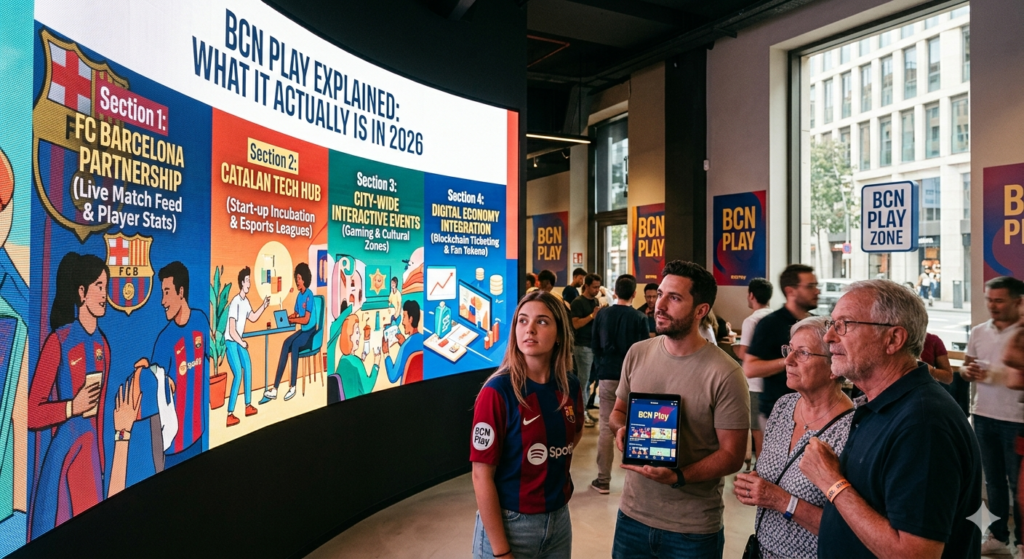

If you’ve typed “bcn play” into a search bar recently and come out more confused than when you started, you’re not alone. The results are a mess — vague platform descriptions, recycled paragraphs, and articles that say the same thing in twelve different ways while somehow explaining nothing. Every article promises to be the “ultimate guide.” None of them actually tells you what the thing is.
This one tries to do that.
What BCN Play Actually Is (And Why It’s Hard to Pin Down)
BCN is the IATA airport code for Barcelona–El Prat Airport. “Play” is, well, play. Put them together and you’ve got a phrase that means genuinely different things depending on where you encounter it — which is a big part of why searching it feels like chasing smoke.
In 2026, bcn play shows up across at least three distinct contexts, and conflating them is what makes most articles about it useless.
First: a digital entertainment concept tied to Barcelona’s creative identity. The city has always had a strong personality around creativity — Gaudí, the Ramblas, Primavera Sound, the design culture that runs through everything from its restaurants to its metro stops. BCN Play, in this reading, is shorthand for the digital extension of that identity. Think interactive experiences, local streaming content, gaming built around Catalan and Spanish culture, and entertainment that doesn’t just import whatever Netflix or Steam is pushing globally.
Second: a specific search keyword people use when hunting a platform or app. A significant chunk of bcn play traffic comes from people trying to locate something concrete — an app, a website, a service — that they heard about through word of mouth or social media. The problem is the term is vague enough that several different services have used it as a brand element, which turns search results into a traffic jam of loosely related pages all claiming to explain the same thing.
Third: a catch-all for Barcelona’s physical play scene. Some of the most legitimate uses of bcn play have nothing to do with phones or screens. Events, escape rooms, bar games, arcades, immersive dining, interactive art spaces — Barcelona has a dense cluster of all of these, and local listings often use “bcn play” as a tag. If you’re in town and looking for things to do, this version of the phrase is arguably the most useful one.
Understanding which of these three you’re dealing with when you search determines whether you find what you’re after.
The Barcelona Background You Need to Know
You can’t fully make sense of bcn play without understanding what kind of city Barcelona actually is in 2026 — because the phrase draws its meaning from that context.
Barcelona is one of Europe’s more tech-forward cities, and that didn’t happen by accident. The city has spent years building out its “smart city” infrastructure: sensor networks in public spaces, open data initiatives, municipal broadband, and a city government that has been unusually willing to experiment with digital services. The 22@ district in Poblenou — once a derelict industrial zone — is now a legitimate tech cluster with startups, design studios, and digital media companies working in old factory buildings.
The Mobile World Congress, the largest mobile technology trade show on earth, happens in Barcelona every February. That alone pulls tens of thousands of tech professionals into the city annually, and it’s created a year-round ecosystem of companies that stay, build, and hire locally. Barcelona has a startup culture that punches above its weight for a city its size.
On top of all that: the city’s universities, particularly UPC (Universitat Politècnica de Catalunya) and UPF (Universitat Pompeu Fabra), produce a steady stream of engineering and design graduates who have largely stayed put rather than leaving for London or Berlin. The talent base is real.
BCN play, in its most coherent form, grows out of all this. It’s not a random phrase someone invented. It reflects a city that has been deliberately building a creative tech identity for two decades.
BCN Play as a Digital Entertainment Platform: What the Term Usually Means
When most people search bcn play in 2026 expecting to find a specific product, they’re looking for a digital entertainment platform — something in the overlap between streaming, gaming, and interactive content. Several services fit that description and have used the bcn play label at various points.
The general shape of what these platforms offer looks like this:
Streaming and on-demand content. Locally produced shows, films, and documentaries that you wouldn’t find on Netflix or Disney+. Catalan-language content specifically, which has a substantial audience. Live events streamed from Barcelona venues — concerts, talks, festivals. Some platforms have also aggregated content from across Spain, making them a regional alternative to the global giants.
Gaming and interactive features. Some bcn play services have built game libraries or partnered with local game studios. Indie games from Spanish and Catalan developers have a presence on these platforms that they simply don’t have on Steam or the App Store, where discoverability is brutal. The bcn play environment gives them a local showcase.
Community and social layers. Several platforms using the bcn play model have added social features — shared playlists, community game nights, event calendars tied to physical Barcelona locations. The idea is to blur the line between the app and the city, so your digital experience connects back to a bar in Gràcia or an art opening in Sant Antoni.
Multilingual access. This matters more than it sounds. Barcelona is trilingual in practice — Catalan, Spanish, and enough English to run a city full of expats and tourists. Platforms that handle all three without awkward switching tend to stick. BCN play services that get this right have an advantage over apps built for a single language market.
None of this is to say there’s one bcn play platform that does all of these things perfectly. There isn’t. The phrase covers a category more than a single product, and the category is still sorting itself out.
Why the Search Results Are So Bad
Somebody has to say it plainly: the bcn play search results are polluted. Not slightly cluttered — genuinely hard to use.
Here’s what happened. The phrase is short, memorable, and Barcelona-adjacent, which made it attractive to content farms looking for keywords with decent volume and low competition. Starting around 2024, a wave of auto-generated articles appeared claiming to explain bcn play comprehensively. They don’t. They repeat the phrase constantly — “bcn play is a platform,” “bcn play offers entertainment,” “bcn play users can enjoy” — without ever grounding any of it in specifics. The articles are identical in structure, written in slightly different word orders, and rank because they all link to each other.
If you’ve read three bcn play articles and walked away knowing less than when you started, that’s exactly why.
The irony is that this makes the actual bcn play services harder to find, not easier. Legitimate platforms get buried under keyword-stuffed noise. Users give up and either find what they’re looking for through Reddit threads or word of mouth, or they don’t find it at all.
For what it’s worth: the best way to cut through the noise is to add specific terms to your search. “BCN play streaming Catalan,” “bcn play Barcelona app iOS,” “bcn play gaming 2026” — any of these get you closer to actual products than the bare phrase alone.
The Physical Side of BCN Play: What’s Actually in the City
If you strip the digital layer away entirely, there’s a thriving physical play scene in Barcelona that the phrase also points toward — and for tourists especially, this is often the most immediately useful version of it.
The Gothic Quarter and El Raval have a high concentration of game bars — places that are half bar, half board game library, open until late. This style of venue has exploded in Barcelona over the past five years. You rent a table for the evening, order drinks, and work through a pile of games. Some are in Catalan or Spanish only, but most of the popular ones have multilingual instructions.
Poblenou is where the more tech-forward physical experiences tend to live. There are digital art spaces — some permanent, some rotating installations — that use projection mapping, motion sensors, and generative AI to create environments you walk through rather than watch. TeamLab has had a presence here. Several local studios have built their own versions. These experiences are genuinely impressive and largely unknown outside the city.
Gràcia and Sant Antoni lean more toward escape rooms and immersive puzzle experiences. There are dozens of these now. Quality varies a lot. The ones run by local creative teams tend to be more original than the franchise operations, and they’re usually cheaper.
The Eixample has a cluster of immersive dining experiences that blend theater with food — you eat a meal while something unfolds around you. These have a mixed reputation (some are tourist traps, some are genuinely good), but they’re part of what “bcn play” gestures at when it’s used to describe physical entertainment.
None of these venues brand themselves “BCN Play” necessarily. But they represent the city’s actual play culture, and that culture is what gives the digital phrase its weight.
Who Actually Searches BCN Play and What They Want
Understanding the audience helps clarify what bcn play means in practice.
Tourists planning a Barcelona trip make up a significant portion of searches. They’ve seen the phrase on a blog or in a travel guide and want to know if it’s an app they should download, a neighborhood they should visit, or just a general description of Barcelona’s vibe. The answer is all three, which isn’t very helpful, which is why they end up reading five useless articles about it.
Barcelona locals and residents — including the city’s large expat community — use it when searching for entertainment options. “BCN play” functions for them the way “things to do in [city]” functions for everyone else. They’re not looking for an explanation of the phrase; they want results.
Developers and small studios in the Barcelona tech scene use it as a brand anchor. If you’re building a game or an app and you want it to read as local, “bcn play” in the name or metadata signals that immediately. It’s a shorthand for the city’s creative identity, and that matters for positioning.
Digital media professionals — journalists, content creators, SEO people — search it because it’s a trending keyword and they want to write about it. The resulting articles are, as discussed, largely not useful. But they drive the search volume up, which makes more people write about it, and here we are.
BCN Play vs. Other European City Entertainment Brands
Barcelona isn’t the only European city with a “city + play” digital identity building around it. London has several platforms using “LDN” branding. Berlin’s startup scene has produced a handful of entertainment apps explicitly tied to the city’s identity. Amsterdam has its own cluster.
What makes bcn play a little different is the cultural specificity underneath it. Barcelona isn’t just trying to be cosmopolitan — it’s working with a distinct language, a distinct cultural tradition, and a political context (Catalan identity, the ongoing tension with the Spanish state) that gives local content a weight it might not have in cities without that backdrop.
Catalan-language content specifically is something that mainstream streaming platforms have handled badly for years. Netflix has some, but the selection is thin and the metadata is often wrong. Spanish-language content is treated as a single category that flattens regional differences. A bcn play platform that takes Catalan content seriously is filling a real gap, not just an imagined one.
That’s a more interesting foundation than most city entertainment brands have. Whether the platforms that use the bcn play label live up to it is a different question, and one that changes by the month.
How to Find a Specific BCN Play Product
If you came here looking for a specific app or service and you still haven’t found it, here’s a practical approach.
Start with the Barcelona city official apps directory — the ajuntament.barcelona.cat site has a running list of officially supported or endorsed digital services, and some bcn play platforms appear there. It’s in Catalan and Spanish, but the app names are searchable.
For entertainment-specific platforms, check the App Store or Google Play with “Barcelona entertainment” or “Barcelona streaming” rather than “bcn play” — you’ll get less noise and more actual products. Reviews from Barcelona-based users are usually the most reliable signal.
Reddit’s r/Barcelona community is genuinely useful here. Locals are forthcoming about which apps are worth installing and which are thin. Search the sub for bcn play and you’ll find threads from people who’ve actually used the products, not content farm summaries.
For physical experiences, Google Maps with the filter set to “entertainment” and your Barcelona neighborhood is still the most reliable tool. The bcn play tag shows up in some listings, but the actual reviews are what tell you whether a venue is good.
The Honest Assessment
BCN play is a phrase that means several real things and also a lot of nothing, depending on which page you landed on. The concept underneath it — Barcelona as a city with a genuine digital creative culture — is legitimate. The city has earned that identity. The entertainment scene, both physical and digital, is real and worth exploring.
What bcn play isn’t, in 2026, is a single defined product with a clear homepage and a five-star rating. It’s a category, a cultural shorthand, and a keyword that’s been somewhat buried by the content that’s tried to explain it.
If you’re visiting Barcelona, the physical play scene will probably serve you better than any app. If you’re a local looking for streaming, digging past the first page of search results is worth the effort. If you’re a developer thinking about using the term for your own product — it’s available, it’s evocative, and the competition for it is mostly content farms, which isn’t exactly a high bar.
The city itself is the clearest version of what bcn play promises. It’s loud, creative, bilingual at minimum, and genuinely interested in making things. Most of what carries the bcn play label is trying to bottle that. Some of it comes close.
Frequently Asked Questions
Is BCN Play a single app or platform? No. It’s a phrase used by multiple apps, platforms, and physical entertainment venues in and around Barcelona. There’s no single official “BCN Play” product with a monopoly on the name.
Does BCN Play offer Catalan-language content? Some platforms using the bcn play label do, and it’s one of the more compelling things they offer. Catalan content is underserved by global streaming platforms, so regional alternatives have a real audience.
Is BCN Play free? Depends entirely on the specific product. Some are free with ads, some are subscription-based, some are free apps tied to paid in-person experiences. You’ll need to check the specific service you’re looking at.
Can I use BCN Play outside Barcelona? For digital platforms, yes — generally you can access content from anywhere, though some live-streaming features are obviously more useful if you’re in the city. For physical experiences, you need to be there.
Why do so many articles about BCN Play say the same thing? Because most of them were generated by the same process. The phrase attracted content farm attention and the results reflect that. This article is an attempt to do something different.