
For nearly two decades, football has revolved around two names. Lionel Messi and Cristiano Ronaldo did not just dominate the sport’s record books; they reshaped how the game is watched, discussed, and remembered. Their rivalry became the defining storyline of a generation, yet what makes their era so remarkable is not that one man won and the other lost, but that two players from entirely different traditions of the game pushed each other, and the sport itself, to heights no one had previously imagined.
Different Origins, Same Destination
Messi’s story began in Rosario, Argentina, where a growth hormone deficiency threatened to end his football dreams before they started. Barcelona’s famous decision to fund his treatment and bring him into La Masia, the club’s youth academy, set him on a path defined by technical artistry. He grew up inside a system built around close control, quick combinations, and positional intelligence, and by his late teens he was already being compared to Diego Maradona.
Ronaldo’s path could not have looked more different. Raised in Madeira in a working-class household, he left home as a young teenager for Sporting Lisbon’s academy, where his explosive athleticism and relentless work ethic stood out long before his technique was refined. Manchester United’s decision to sign him as a teenager exposed him early to the physical demands of the Premier League, and under Alex Ferguson’s guidance he transformed from a flashy winger into a complete, ruthlessly efficient goal-scoring machine.
By the time both men were established at the top of European football, one in Catalonia and the other first in Manchester and then Madrid, the contrast in their footballing identities was already obvious. Messi played as though the game came to him; Ronaldo looked as though he was bending the game to his will through sheer physical dominance and self-discipline.
The Clásico Years
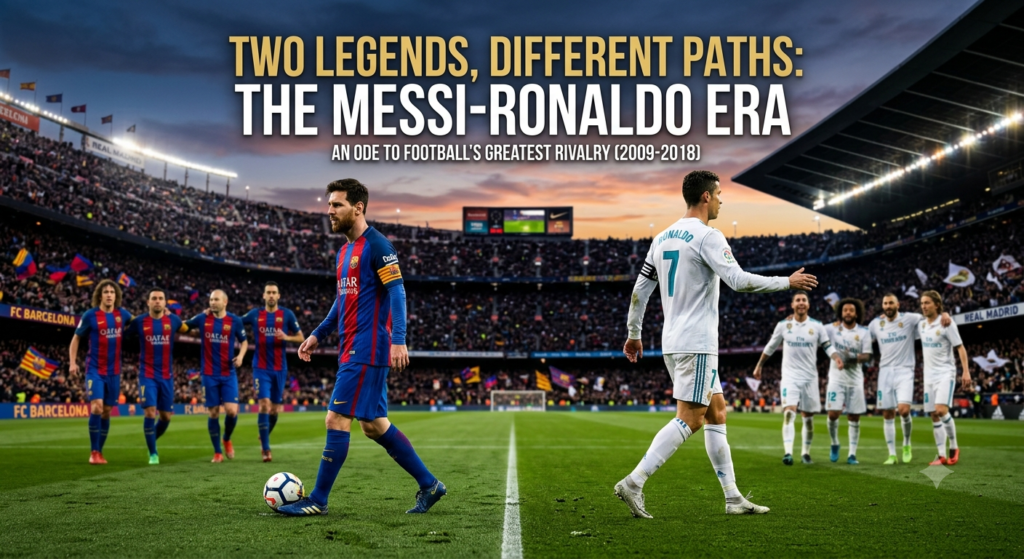
The rivalry reached its most intense form between 2009 and 2018, when Messi anchored Barcelona and Ronaldo led Real Madrid. El Clásico stopped being simply a club fixture and became a global event built almost entirely around the duel between the two. Season after season, they traded Ballon d’Or awards, Golden Boots, and Champions League campaigns, each pushing the other to remarkable individual tallies that no other player in history has approached.
Messi’s game during this period was built on close dribbling in tight spaces, vision that consistently set up teammates, and a knack for scoring goals that looked almost effortless. Ronaldo’s was built on power, aerial ability, and a relentless drive to refine his body and his finishing until he became arguably the most clinical striker the sport had seen. Neither man’s approach was objectively superior; they simply represented two different blueprints for footballing greatness, and fans spent over a decade arguing over which blueprint mattered more.
Diverging Roads
Eventually, their paths split. Ronaldo left Real Madrid for Juventus in 2018, chasing a new challenge in Italy before an emotional return to Manchester United in 2021. Messi, after spending his entire senior career at Barcelona, left the club in 2021 amid financial turmoil and joined Paris Saint-Germain, a move that surprised much of the football world.
What followed cemented just how different their later careers would become. Messi finally captured the one trophy that had eluded him for years, lifting the World Cup with Argentina in Qatar in 2022 in a final widely regarded as one of the greatest matches ever played. Ronaldo, despite leading Portugal to European Championship glory in 2016 and to two UEFA Nations League titles, has never won the World Cup, a gap in his trophy case that remains the most cited argument in debates about his legacy.
Both men eventually moved away from Europe’s traditional powerhouses. Ronaldo joined Saudi Arabia’s Al-Nassr in early 2023, a transfer that helped accelerate a wave of global investment in the Saudi Pro League. Messi headed to Major League Soccer with Inter Miami later that year, a move that transformed the profile of American soccer almost overnight and delivered the club its first major trophies. Each man, in his own way, became an ambassador for a league trying to establish itself on the world stage, just as each approached the end of his career from a different continent and in a different kind of football.
One Last Act, Side by Side
Remarkably, both players’ stories are converging again at the 2026 World Cup, hosted across the United States, Mexico, and Canada. At 41 and 38 respectively, Ronaldo and Messi are each appearing in their sixth World Cup, a record neither man held alone before this tournament. Both are widely expected to retire from international football once the competition ends, closing the international chapter of a rivalry that began in earnest back when both were still teenagers breaking into their national teams.
It is a fitting symmetry. Two players who built their legacies through almost opposite means, one through artistry and improvisation, the other through power and relentless self-improvement, are stepping off the same global stage at nearly the same moment, decades after they first stepped onto it.
A Legacy Bigger Than the Argument
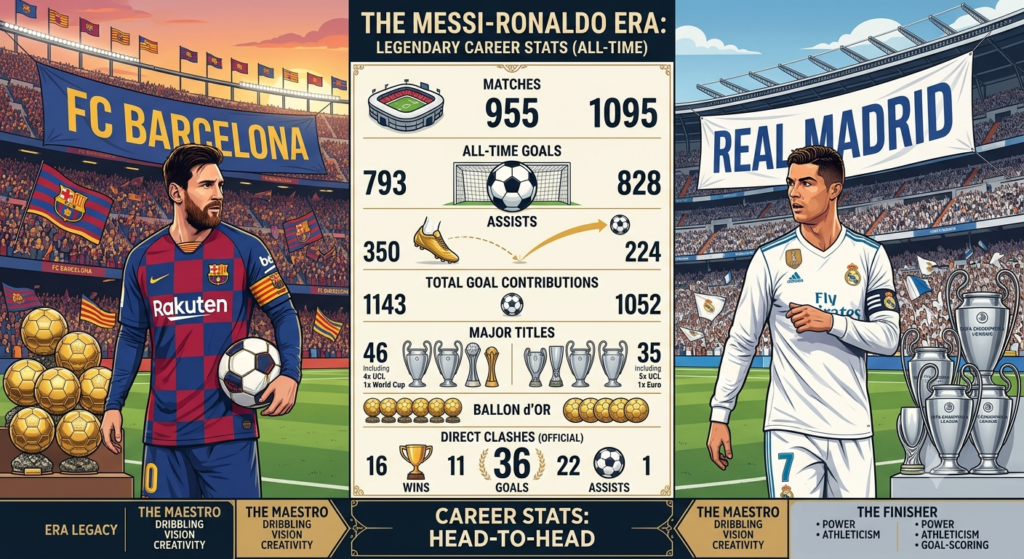
The temptation to declare a winner in the Messi-Ronaldo debate has never gone away, and it probably never will. But reducing their era to a simple verdict misses what made it so compelling in the first place. Messi and Ronaldo did not just compete against each other; they competed against the limits of what a footballer could achieve, and in doing so they pulled an entire sport forward with them.
Their statistics will keep being compared for decades. Their styles will keep being debated in pubs, group chats, and television panels long after both have retired. But what truly defines the Messi-Ronaldo era is not which man finished on top. It is that two completely different paths, one built on instinct and the other on relentless discipline, both led to the same destination: greatness that the sport had never seen before, and may never see again in quite the same form.