

Introduction
Every few years, a concept emerges from the edges of academic research and engineering labs that quietly rewires the way we think about technology. It rarely announces itself with fanfare. Instead, it seeps into conversations, appears in whitepapers, and suddenly you’re hearing it everywhere — from AI conferences to startup pitch decks. Today, that concept is chas6d.
Short for Cybernetic Hierarchical Adaptive Systems in Six Dimensions, chas6d is no longer just a niche theoretical model debated in university corridors. It has become a living framework — one that is actively shaping how developers, engineers, and digital architects design the intelligent systems of tomorrow. Whether you’re building autonomous robots, smart city infrastructure, or adaptive AI platforms, chas6d is increasingly the lens through which the most forward-thinking technologists are viewing their work.
But what exactly is chas6d? Why is it rising now? And what does its ascent mean for the future of technology? This article explores all of that — and more.
What Is Chas6d?
At its core, chas6d is a conceptual and operational framework that describes how complex, intelligent systems can learn, adapt, and evolve across six interconnected dimensions. It draws from three foundational disciplines:
Cybernetics — the study of feedback loops and self-regulation in systems, whether biological, mechanical, or digital. In the chas6d model, cybernetic principles ensure that a system can continuously monitor its environment, evaluate its own performance, and course-correct in real time.
Hierarchical Architecture — the idea that systems are most effective when organized into layers, with each level performing specific functions and reporting to higher levels of control. In chas6d, this hierarchy allows even the most complex decisions to be broken down into manageable, coordinated tasks across the system.
Adaptive Intelligence — perhaps the most powerful pillar of chas6d. Rather than following a fixed set of rules, a chas6d-based system learns from every interaction, updating its internal models and improving its future responses. This is what makes chas6d fundamentally different from traditional software architectures.
Together, these three principles form the “CHA” in chas6d. The “6D” refers to the six operational dimensions that define how a chas6d system perceives, processes, and engages with the world.
The Six Dimensions of Chas6d
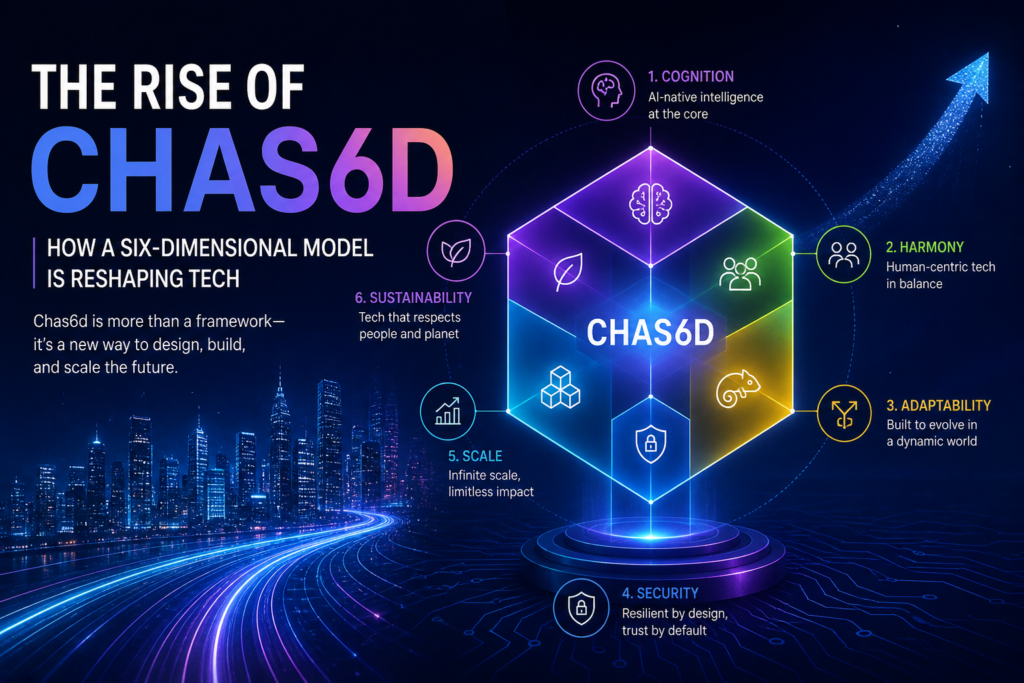
One of the most compelling aspects of chas6d is its multi-dimensional structure. Unlike flat, single-layer models, chas6d operates across six distinct but deeply integrated dimensions:
1. The Physical Dimension connects the system to the real world through hardware, sensors, and physical devices. This is where chas6d meets the environment — collecting raw data and translating physical reality into digital signals.
2. The Cognitive Dimension is the thinking layer. Here, chas6d processes incoming data, identifies patterns, and generates intelligent decisions. It is the reasoning engine — the part of the system that resembles human thought most closely.
3. The Adaptive Dimension is where chas6d truly earns its name. This layer enables learning. Every action taken feeds back into the system, which evaluates the outcome and adjusts its approach for the next cycle. It is a continuous loop of self-improvement that never stops.
4. The Communicative Dimension governs how components of a chas6d system communicate with one another and with external systems. In a world of interconnected devices and distributed computing, this dimension is critical for ensuring coherence and responsiveness at scale.
5. The Social Dimension recognizes that intelligent systems do not operate in isolation. They interact with humans, organizations, and other systems. Chas6d’s social dimension provides the framework for these interactions to be meaningful, ethical, and productive.
6. The Ethical Dimension may be the most significant of all. As AI systems grow more powerful, questions about accountability, bias, and responsible decision-making have become impossible to ignore. Chas6d addresses this directly by embedding ethical reasoning into the architecture itself — not as an afterthought, but as a core operating dimension.
This six-dimensional structure is what gives chas6d its remarkable versatility. A system built on chas6d principles is not simply automated — it is aware, adaptive, communicative, and conscientious.
Why Chas6d Is Rising Now
The timing of chas6d’s emergence is not accidental. Several converging forces in the technology landscape have created exactly the conditions in which a framework like chas6d can thrive.
The limits of traditional AI are showing. Rule-based systems and even early machine learning models struggle with novelty — situations they weren’t explicitly trained for. Chas6d offers a path beyond this limitation. By embedding adaptive learning at every hierarchical level, a chas6d system can handle the unexpected without breaking down.
The complexity of digital infrastructure has exploded. Modern systems — from cloud networks and IoT ecosystems to autonomous vehicles and smart cities — are not just complicated. They are complex in the truest sense: countless interacting parts, dynamic environments, and unpredictable feedback loops. Chas6d was built precisely for this kind of complexity.
Ethical AI has moved from philosophy to policy. Governments, regulators, and the public are demanding more from AI systems. They want transparency, accountability, and built-in safeguards. Chas6d’s ethical dimension answers this call in a way that most conventional frameworks cannot.
Real-time adaptability is now a competitive necessity. In industries from healthcare to finance, the ability of a system to learn and respond in real time is no longer a luxury — it is a baseline requirement. Chas6d delivers this natively.
Chas6d in the Real World
The practical applications of chas6d are as broad as technology itself. Early implementations have already demonstrated the framework’s potential across several key sectors.
- In Healthcare, chas6d is enabling adaptive treatment systems that personalize care based on individual patient data. Rather than applying a one-size-fits-all protocol, a chas6d-powered system continuously refines its recommendations as it learns more about the patient — accounting for new symptoms, drug interactions, and evolving medical research.
- In Smart Cities, chas6d is being used to manage the staggering complexity of interconnected urban infrastructure. Traffic signals, energy grids, emergency response systems, and public transit networks can all be coordinated through a chas6d framework — each system learning from the others, adapting in real time, and optimizing for the collective good of the city.
- In Robotics, chas6d allows machines to navigate environments that no programmer could fully anticipate in advance. A chas6d-enabled robot doesn’t just execute commands — it observes, learns, and adapts, becoming more capable with every task it performs.
- In Cybersecurity, chas6d’s hierarchical and adaptive architecture makes it extraordinarily effective at threat detection and response. Traditional security systems look for known attack signatures. A chas6d system learns what “normal” looks like across all six dimensions and flags anomalies — even novel threats it has never encountered before.
- In Digital Platforms and Communities, chas6d informs how environments are designed for user engagement, security, and scalability. The framework’s principles guide how platforms can grow intelligently — adapting to user behavior, identifying friction points, and evolving to meet new needs without losing cohesion.
Chas6d as a Design Philosophy
Beyond its technical applications, chas6d is gaining traction as a broader design philosophy — a way of thinking about any complex system, human or digital.
Some product designers and architects are applying chas6d principles to physical spaces — buildings, urban environments, and public infrastructure designed to adapt to human behavior over time. Others are using chas6d as a workflow framework, breaking complex projects into six stages — Clarify, Hypothesize, Analyze, Strategize, Develop, Deliver — that mirror the system’s six operational dimensions.
This conceptual flexibility is one of chas6d’s most underappreciated strengths. It is not a rigid software specification or a proprietary tool. It is a way of understanding how intelligence — whether artificial or human — can be structured to grow, adapt, and remain effective in a world that never stops changing.
The Road Ahead for Chas6d
Chas6d is still in its ascent. Most implementations remain at the experimental or early-deployment stage, and the broader tech industry is only beginning to appreciate the framework’s full potential. But the trajectory is clear.
As AI systems grow more powerful and more embedded in critical infrastructure, the demand for frameworks that go beyond automation — that can learn, adapt, communicate, and reason ethically — will only intensify. Chas6d is uniquely positioned to meet that demand.
Academic interest in chas6d is accelerating. Research groups across disciplines — computer science, systems engineering, biomedical informatics, and urban planning — are exploring how the framework can be applied to their specific challenges. Corporate innovation labs are experimenting with chas6d-based architectures in next-generation products. And the policy community is beginning to recognize that frameworks like chas6d may offer a principled path toward AI systems that are not just powerful, but trustworthy.
Conclusion
The rise of chas6d is not a story about a new programming language or a breakthrough hardware platform. It is a story about a shift in how we think — about intelligence, about systems, and about the relationship between technology and the humans it serves.
In a world of increasing complexity, chas6d offers something rare: a coherent, principled, and genuinely adaptive framework for building systems that can rise to meet whatever challenges the future brings. It does not promise perfection. It promises something better — continuous learning, structured intelligence, and the capacity to grow.
That, in the end, is why chas6d is not just reshaping tech. It is reshaping the way we imagine what technology can be.